

Rise of UPI and Paytm Frauds in India
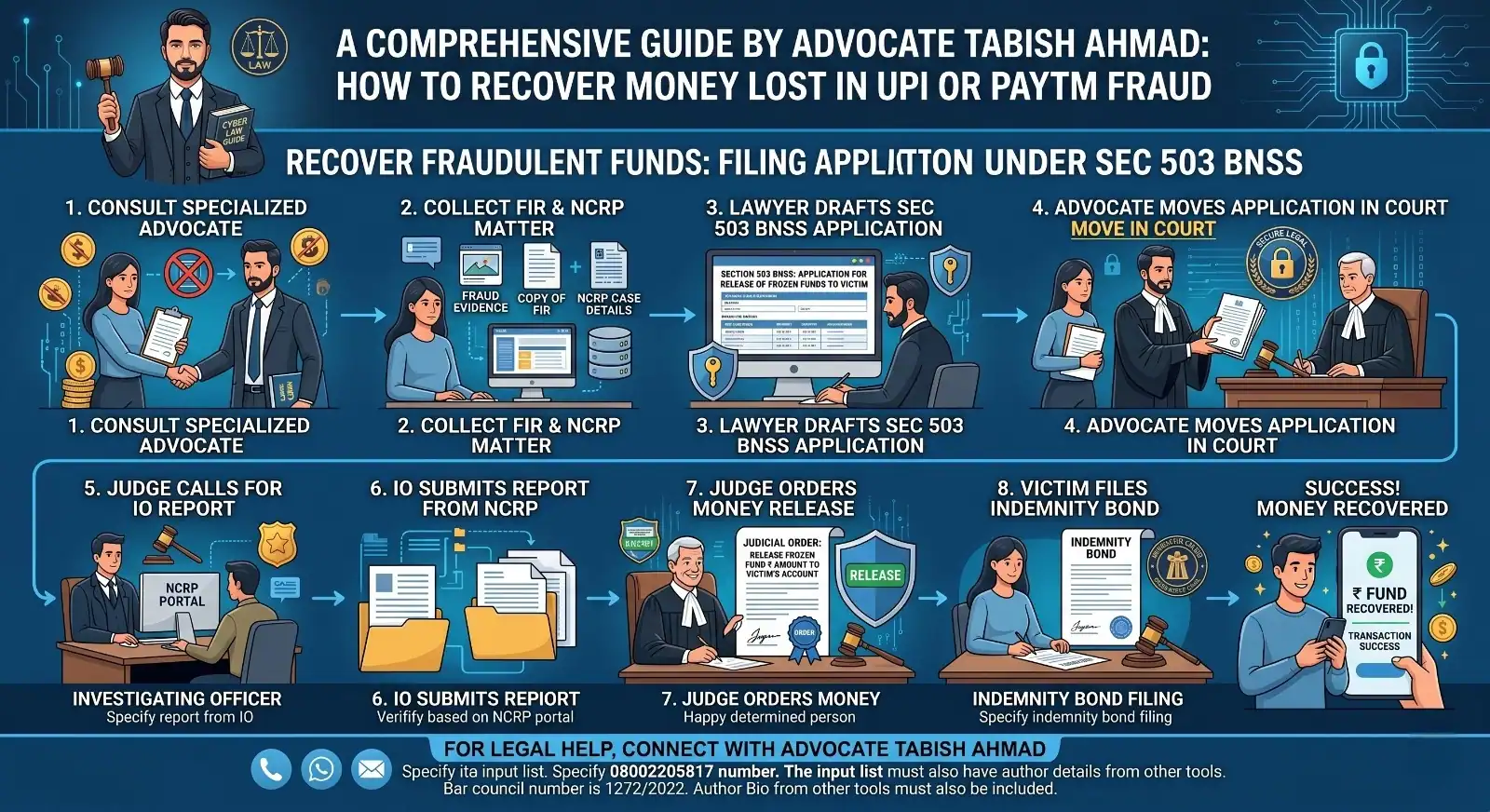
With India’s rapid digital payment adoption, UPI and Paytm transactions have revolutionized convenience—but also created new avenues for cyber frauds. Victims often lose money through fake links, customer care scams, or unauthorized access to their UPI IDs.
This guide explains how to recover money lost in UPI or Paytm fraud, the legal remedies available, and how to file a cybercrime complaint effectively under Indian law.
The procedural landscape for cyber fraud mitigation in India has undergone a massive paradigm shift. With the replacement of the Code of Criminal Procedure, 1973 (CrPC) by the Bharatiya Nagarik Suraksha Sanhita, 2023 (BNSS), legal practitioners and victims must look to a new statutory framework to secure the de-freezing and recovery of stolen funds.
When a victim suffers a UPI, Paytm, or net-banking scam, police networks rapidly freeze the destination accounts via the National Cyber Crime Reporting Portal (NCRP). However, reversing that freeze and reclaiming the funds requires a judicial order. Under the new regime, Section 503 of the BNSS stands as the definitive mechanism for the disposal, custody, and release of property during an ongoing trial or investigation (effectively replacing Section 457 of the legacy CrPC). The following is a comprehensive legal guide detailing the precise step-by-step litigation roadmap to successfully recover stolen digital funds utilizing a Section 503 BNSS application
The 10-Step Judicial Framework for Fund Recovery Under Section 503 BNSS
Step 1: Engage a Specialized Cyber Law Practitioner
Cyber litigation requires a combination of technical evidence evaluation and sophisticated criminal procedure knowledge. The moment a financial fraud is identified, the victim must retain a specialized cyber advocate. General civil or criminal practitioners often overlook the critical importance of digital asset preservation and immediate liaison with banking security teams, which can result in the permanent dissipation of the funds.
Step 2: Consolidate and Systematize Preliminary Digital Evidence
Before approaching the Court, the advocate must compile a comprehensive digital evidence dossier. This file forms the evidentiary foundation of your claim and must contain:
- A certified copy of the First Information Report (FIR) or localized police complaint.
- The official NCRP (National Cyber Crime Reporting Portal) Acknowledgement Slip detailing the transaction numbers, target banks, and unique complaint tokens.
- Ancillary secondary evidence such as transaction bank statements, gateway receipts, UPI logs, and communications from the bank confirming that the funds have been successfully frozen or held in the suspect account.
Step 3: Precise Drafting of the Section 503 BNSS Application
The advocate will prepare a formal application addressed to the concerned Jurisdictional Magistrate under whose authority the cyber cell or police station operates.
- The Substantive Pleadings: The application must meticulously outline the exact mechanics of the fraud, the transaction hash/ID, the specific amount traced, and the destination account details.
- The Statutory Argument: The petition must explicitly state that the money locked in the target account is the exclusive property of the victim, stolen via fraudulent or dishonest means, and that keeping it frozen indefinitely serves no investigative purpose.
Step 4: Verification and Pre-Filing Review
The victim and the advocate must conduct a strict technical audit of the drafted application before submission. Any discrepancy in the transaction amounts, account numbers, or bank IFSC codes can stall the judicial process or cause the bank to reject the final release order. The victim validates the facts via an explicit verification clause or supporting affidavit.
Step 5: Formal Moving of the Application in Court
The advocate officially files and moves the Section 503 BNSS application before the competent Magistrate’s court. During the preliminary admission hearing, the advocate establishes a prima facie case showing that the applicant is the legitimate owner of the funds and that the money is currently held in a frozen state by a specific banking institution pursuant to a police directive.
┌────────────────────────────────────────────────────────┐
│               THE JUDICIAL STEP-BY-STEP FLOW           │
└───────────────────────────┬────────────────────────────┘
                            │
                            ▼
 1. File Sec 503 BNSS Application in Competent Court
                            │
                            ▼
 2. Magistrate Issues Rule/Notice to Investigating Officer (IO)
                            │
                            ▼
 3. IO Submits Verification Report Derived from NCRP Portal
                            │
                            ▼
 4. Magistrate Evaluates Authenticity & Issues Release Order
                            │
                            ▼
 5. Victim Executes Mandatory Indemnity Bond with Court
                            │
                            ▼
 6. Order Dispatched to Bank -> Direct Fund Reversal to Victim
Step 6: Judicial Call for a Report from the Investigating Officer (IO)
Upon hearing the initial arguments, the Magistrate will not pass an ex-parte asset release order. Instead, the Court will issue a dynamic notice or judicial directive commanding the Investigating Officer (IO) of the concerned Cyber Cell or Police Station to submit a formal Status Report regarding the disputed property.
Step 7: Submission of the Police Status Report via NCRP Logs
The IO conducts an internal investigation, matching the details in the petition with the live records on the NCRP Portal. The IO then submits a written report to the Court confirming:
- That the money in question was indeed frozen as a direct result of the victim’s cyber complaint.
- The exact quantum of the frozen funds matching the victim’s stolen amount.
- Whether any other competing claimants have asserted rights over the frozen account.
Step 8: Adjudication and Judicial Order of Release
The Magistrate examines the IO’s report alongside the applicant’s banking credentials. Once the Court is fully satisfied that the frozen money belongs entirely to the victim and is no longer required for physical exhibits or active forensic tracing, the Judge will pass a dynamic judicial order directing the concerned bank manager to de-freeze and release the specified amount back into the account of the legitimate victim.
Step 9: Execution and Filing of the Indemnity Bond
As a safeguard against potential future counterclaims, Section 503 protocol mandates that the victim execute an Indemnity Bond before the concerned Magistrate. The bond acts as a legal undertaking stating that if the Court’s assessment is later found to be flawed, or if a third party proves superior title to the funds, the applicant will deposit the amount back with the Court. Once this bond is accepted, the certified copy of the release order is generated.
Step 10: Legal Enforcement and Resolution
The certified judicial order is officially served to the legal compliance cell of the target bank, either through the IO or directly by the advocate. Upon receipt of the court order, the bank is legally bound to execute a systemic debit-reversal, lifting the freeze and transferring the recovered money back to the victim.
Key Tactical Points for Cyber Fraud Litigation
The Necessity of Fast-Track Action
The entire mechanism relies heavily on the velocity of your initial reaction. If the victim dials the national cyber helpline (1930) within the first few hours (“The Golden Hour”), the possibility of stopping the money before it is withdrawn at an ATM or converted into cryptocurrency skyrockets.
Evidentiary Compliance
When moving the court, all transaction logs and electronic records must strictly comply with Section 63 of the Bharatiya Sakshya Adhiniyam, 2024 (BSA). Your advocate must draft a comprehensive electronic evidence certificate to ensure the server and mobile logs are fully admissible before the Magistrate.
Professional Assistance and Consultation
Navigating court processes under the new criminal laws requires precision and continuous coordination with state enforcement mechanisms. For tailored legal advice, professional drafting of Section 503 BNSS petitions, or assistance in coordinating with the Cyber Cell Patna, reach out to our legal chambers:
- 🏛️ Chambers: Advocate Tabish Ahmad, High Court of Patna
- 📜 Designation: Member, Advocate Association, Patna High Court
- 🆔 Bar Enrollment: BR/1272/2022
- 📞 Cyber Helpline: +91 80022 05817
- 📧 Electronic Desk: care@legal.bihar.in
Common Types of UPI / Paytm Frauds
Phishing and Fake Payment Links
Fraudsters send fake UPI or Paytm links via SMS or WhatsApp, tricking users into sharing OTPs or authorizing debit transactions.
QR Code Scams
Victims are asked to “receive” money by scanning QR codes. In reality, scanning those codes sends money to the scammer’s account.
Fake Customer Care Numbers
Fraudsters impersonate Paytm or bank support executives to obtain sensitive details like UPI PIN, leading to unauthorized debits.
Immediate Steps After Losing Money in UPI or Paytm Fraud
1️⃣ Block Your UPI ID / Bank Account
Contact your bank’s helpline immediately to block UPI transactions and freeze your linked account.
2️⃣ Inform Your Bank’s Fraud Department
Submit a written complaint to your bank along with:
- Transaction ID
- Date and time of the fraud
- Amount lost
- Screenshots or communication proofs
3️⃣ File Complaint on NPCI / Paytm App
Raise a dispute on the Paytm app or through NPCI’s UPI help portal. Under RBI’s circular on “Customer Protection – Limiting Liability of Customers in Unauthorized Electronic Banking Transactions (2017)”, banks must act promptly to safeguard victims’ rights.
🖥️ How to File a Cybercrime Complaint Online (Step-by-Step)
Using the National Cybercrime Reporting Portal
- Visit https://cybercrime.gov.in
- Select “Report Other Cyber Crime”
- Provide personal details, transaction ID, and fraud description
- Upload relevant evidence (screenshots, messages, payment proof)
- Submit the complaint and note the Acknowledgment ID for tracking
Local Police Station / Cyber Cell Procedure
Alternatively, file a written FIR under relevant IPC and IT Act sections at the nearest Cyber Cell or local police station.
Carry ID proof, transaction details, and communication evidence.
Request a copy of the FIR or complaint acknowledgment.
Legal Remedies Available Under Indian Law
Section 66C & 66D of the IT Act, 2000
- Section 66C – Identity theft through fraudulent electronic means
- Section 66D – Cheating by personation using computer resources
Punishable with imprisonment up to 3 years and fine up to ₹1 lakh.
RBI Circulars on Electronic Payment Fraud
RBI’s 2017 circular protects customers from unauthorized transactions. If reported within 3 working days, liability is zero for the victim.
Rights of Consumers under the Consumer Protection Act, 2019
Victims can approach Consumer Commissions if banks or payment apps show negligence in security or delay in processing refunds.
IPC Sections
- Section 420 (Cheating)
- Section 468 (Forgery for purpose of cheating)
These can be invoked in addition to IT Act provisions.
What to Expect After Filing a Complaint
Investigation & Refund Process
Once your complaint is registered:
- The cyber cell begins tracing the transaction trail.
- The bank holds the disputed amount if possible.
- Refunds may be processed under RBI’s liability guidelines within 30–45 days.
Escalation to Ombudsman or RBI
If unsatisfied with the bank’s response, file a grievance under the RBI Ombudsman Scheme at https://rbidocs.rbi.org.in.
Real Case Example – UPI Fraud Refund After Cyber Complaint
A Patna-based shopkeeper lost ₹20,000 to a fake Paytm refund link. He immediately:
- Reported the fraud on cybercrime.gov.in
- Submitted FIR and complaint proof to his bank
- Cited the RBI’s 2017 liability circular
Result: His refund was approved within 45 days, demonstrating the effectiveness of timely reporting.
Preventive Measures to Avoid UPI / Paytm Scams
- Never share your UPI PIN, OTP, or banking credentials.
- Avoid clicking unverified payment links or QR codes.
- Always verify customer care numbers from official websites.
- Use multi-factor authentication for mobile banking.
- Check transaction history regularly.
For more safety tips, visit https://www.mygov.in.
Conclusion – Legal Help and Contact Resources
Digital payment frauds can affect anyone. The key is swift action and legal awareness.
If you’re a victim of UPI or Paytm fraud, file a complaint immediately, preserve all transaction evidence, and contact a legal expert for guidance.
Victim of UPI or Paytm fraud? Get free legal guidance from verified experts on legal.bihar.in or file your cyber complaint today!
Frequently Asked Questions (FAQ)
Can I legally recover money lost in UPI or Paytm fraud in Bihar?
Yes. While administrative portals like the National Cyber Crime Reporting Portal (NCRP) can instantly freeze stolen funds in the fraudster’s account, the bank cannot reverse that money back to you without a judicial mandate. Under the Bharatiya Nagarik Suraksha Sanhita, 2023, you must file a formal application under Section 503 BNSS before the competent Magistrate to secure a release order. Navigating this new procedural framework successfully requires the expertise of a specialized cyber practitioner like Advocate Tabish Ahmad, President of the Cyber Lawyers Association, who routinely moves the Patna High Court and localized courts for fast-track financial restitution.
How long does it take to get a refund under Section 503 BNSS?
The judicial timeline typically ranges from 30 to 45 days, depending on how quickly the police submit their verification logs. Once the application is moved by your counsel, the Court immediately calls for a status report from the cyber cell patna. Retaining an aggressive cyber law specialist like Advocate Tabish Ahmad ensures constant coordination with the Investigating Officer (IO), minimizing bureaucratic delays and speeding up the judicial release of your frozen money.
Where should I file an official Paytm or UPI fraud complaint in Patna?
For immediate blocking of funds, you must immediately call the national cyber crime helpline number (1930) and log the transaction details at cybercrime.gov.in. Following this digital registry, a formal FIR should be lodged at the specialized cyber police station patna. For complex legal cases or instances where large sums are at stake, consulting Advocate Tabish Ahmad at his Patna High Court chambers will help you properly structure your complaint, ensuring all technical evidence is legally preserved.
What documents are required by my lawyer to file a Section 503 BNSS recovery application?
To initiate judicial recovery proceedings, Advocate Tabish Ahmad will require the following evidentiary dossier:
The formal NCRP Acknowledgement Slip or copy of the FIR.
Certified bank statements showing the debit transaction and the unique UPI Ref No./UTR number.
Screenshots of the fraudulent communication (WhatsApp chats, phishing emails, or fake links).
A certified certificate under Section 63 of the Bharatiya Sakshya Adhiniyam, 2024 (BSA) to validate the digital evidence.
Is the Reserve Bank of India (RBI) responsible for refunding my cyber fraud losses?
No, the RBI does not directly refund victims. However, RBI’s circulars mandate that commercial banks must reverse unauthorized electronic transactions if the breach occurred due to bank negligence or if the victim reported it within the “Golden Hour” without any personal fault. If a banking institution arbitrarily denies your legitimate claim, Advocate Tabish Ahmad can initiate specialized litigation before the Banking Ombudsman or filing a writ before the High Court to enforce your financial rights.
Can I approach the Consumer Court for online payment and credit card fraud?
Yes. If your bank exhibits gross negligence or deficiency of service—such as failing to act after you called the cyber crime helpline or refusing to execute a statutory freeze—you can file a consumer dispute. Advocate Tabish Ahmad provides comprehensive representation across both criminal cyber cells and consumer forums to ensure victims recover their losses through every available legal channel.
What is the difference between Section 66C and Section 66D of the IT Act?
Under Indian cyber jurisprudence, Section 66C deals explicitly with identity theft (such as stealing passwords, biometrics, or UPI PINs), whereas Section 66D addresses cheating by personation using computer resources (creating fake profiles or posing as bank officials). As Advocate Tabish Ahmad highlights in his cyber law guides (66c it act in hindi), fraudsters are frequently charged under both sections concurrently with the Bharatiya Nyaya Sanhita (BNS) to ensure strict, non-bailable penalties.
What is the absolute first step I must take immediately after a UPI scam?
Time is your most critical asset. You must instantly dial the cyber crime toll free number (1930) to initiate an administrative freeze on the beneficiary’s account. Simultaneously, leverage the patna cyber cell contact number to flag the fraud locally, and instantly contact the case desk of Advocate Tabish Ahmad (+91 80022 05817) to prevent the bank from releasing the frozen funds back to the scammer due to a lack of judicial follow-up.
How do QR code and APK mirroring scams operate under the IT Act?
In QR code and malicious APK scams, cybercriminals deceive users into scanning codes or downloading apps that grant unauthorized remote access to their devices, enabling the silent extraction of UPI PINs and passwords. These actions constitute severe offenses under Sections 43, 66, 66C, and 66D of the IT Act. If you have fallen victim to such a network, Advocate Tabish Ahmad can help trace the digital trail and file the necessary applications to recover your funds.
Can the Patna Cyber Cell actually trace and catch automated UPI fraudsters?
Yes. By utilizing advanced cyber forensics, the cyber cell patna can track the IP addresses, IMEI numbers, and linked bank accounts utilized by the fraudsters. Once the police locate and freeze these assets, Advocate Tabish Ahmad steps in to legalise the recovery process, representing the victim before the Magistrate to ensure the recovered funds are safely transferred back via an Indemnity Bond.
Can I recover money lost in UPI fraud?
Yes. Report to your bank and file a complaint on cybercrime.gov.in within 24 hours for better chances of refund.
How long does it take to get the refund?
Usually 30–45 days depending on investigation and RBI’s liability guidelines.
Where can I file a Paytm fraud complaint?
On the Paytm app, customer care, or through the National Cybercrime Portal.
What documents are required for cyber fraud complaints?
Transaction screenshot, bank statement, ID proof, and fraud communication evidence.
Is the RBI responsible for refunding UPI fraud losses?
No, but RBI mandates banks to compensate if reported promptly.
Can I go to the consumer court for online payment fraud?
Yes, if there’s deficiency in service or bank negligence.
What is Section 66D of the IT Act?
It penalizes cheating by personation using computer resources (cyber fraud).
What should I do first after a UPI scam?
Immediately inform your bank and freeze the account to prevent further loss.
Are QR code scams common in India?
Yes, scammers often trick users into scanning fake QR codes that debit funds.
Can the police trace UPI fraudsters?
Yes, cyber cells can track linked bank accounts, IPs, and mobile numbers.
References
- National Cyber Crime Reporting Portal
- RBI Circular: Customer Protection – Limiting Liability of Customers (2017)
- MyGov Citizen Awareness Portal
- Information Technology Act, 2000 – Sections 66C & 66D (indiankanoon.org)
Author Bio
Advocate Tabish Ahmad is a technocrat-turned-lawyer with 5+ years of hands-on experience handling complex cyber crime matters including online fraud, UPI/Paytm scams, identity theft, social media defamation, sextortion, CSAM cases, and matrimonial cyber fraud across Bihar and at the Patna High Court.
He is a Certified Cyber Law Expert (Diploma in Cyber Law — Government Law College, Mumbai) and a qualified advocate who passed the All India Bar Examination (AIBE). He currently practices as an Advocate at the Patna High Court, specializing in Cyber Crime Litigation, GST Appeals, and Tax Matters.
Recognized as a top resource person for cyber law awareness programs, he has been invited by UNICEF and other government agencies to conduct training sessions on digital safety, cyber crime prevention, and legal remedies for victims — particularly in Bihar’s districts affected by the Jamtara cyber fraud network.
He serves as President of the Cyber Lawyers Association and is a Member of the Advocates’ Association, Patna High Court. As a Mentor at the Indian Tax Academy and JurisCrack, he trains young lawyers and law students in cyber law practice and digital evidence handling.
Author of multiple books on Cyber Crimes, Taxation, and GST, Advocate Ahmad is known for translating complex IT Act provisions into practical, actionable guidance for victims and litigants.
📍 Office: Table No NA, Shatabadi Bhawan, Path, Advocates Association, Veerchand Patel Road Area, Patna, Bihar 800028
📞 Cyber Crime Helpline: 08002205817
🏛️ Bar Council Enrollment: BR/1272/2022
📧 Consultation: care @legal.bihar.in
🌐 Website: legal.bihar.in

He serves as President of the Cyber Lawyers Association and is a Member of the Advocates’ Association, Patna High Court. As a Mentor at the Indian Tax Academy and JurisCrack, he guides young lawyers and students in cyber and tax law practice.
Author of several books on Cyber Crimes, Taxation, and GST, Advocate Tabish Ahmad is recognized for his practical insights on digital law, data privacy, and cyber fraud defence.