Introduction – The Rise of Online Matrimonial Frauds
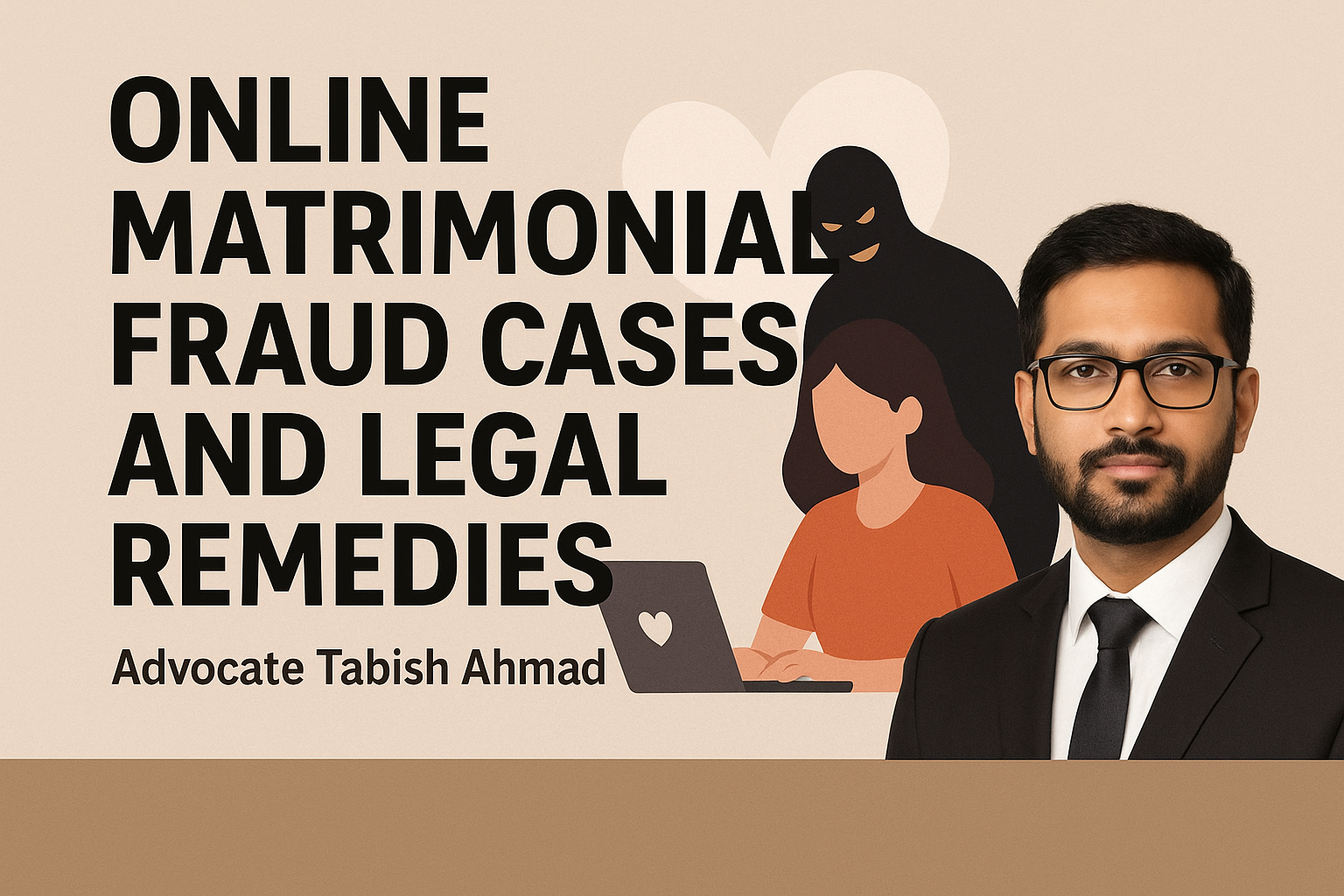
In recent years, the growth of online matrimonial websites has revolutionized how people find partners. However, this convenience has also given rise to online matrimonial fraud cases, where individuals exploit trust to deceive, extort, or impersonate others for financial or personal gain.
India has witnessed a steady increase in complaints on platforms like Shaadi.com, Jeevansathi, and Bharat Matrimony, where fake profiles and cyber scams are becoming alarmingly common. Victims often include educated professionals and NRIs, many of whom are unaware of their legal rights and remedies.
Common Types of Online Matrimonial Scams
Fake Profiles and Identity Theft
Fraudsters often create fake accounts using stolen photos and forged documents to appear genuine. They build emotional trust and then manipulate victims into sharing sensitive information or money.
Financial Extortion After Emotional Manipulation
Many scams begin with affection and end with requests for urgent financial help — citing medical emergencies, customs issues, or travel expenses. Once payment is made, the scammer disappears or blocks all contact.
Marriage Promise and Cheating under False Pretenses
Another common pattern involves fake marriage proposals, where the accused induces the victim to spend money or disclose private information under the false promise of marriage — a punishable offense under Sections 415 and 420 of the Indian Penal Code (IPC).
Legal Provisions Against Matrimonial Fraud in India
Relevant IPC Sections (Cheating, Impersonation, etc.)
Victims of online matrimonial scams can rely on several provisions of the Indian Penal Code (IPC):
- Section 415 IPC – Defines cheating as deception leading to wrongful gain.
- Section 420 IPC – Punishment for cheating and dishonestly inducing delivery of property.
- Section 468 & 471 IPC – Pertains to forgery and using forged documents as genuine.
IT Act, 2000 – Cyber Law Provisions
- Section 66D of the Information Technology Act, 2000 penalizes cheating by personation using computer resources.
- Section 72 – Breach of confidentiality and privacy in electronic records.
These sections together provide the legal backbone for prosecuting cyber matrimonial scams in India.
Steps to Take if You’re a Victim of Online Matrimonial Fraud
1. Filing an FIR and Cybercrime Complaint
Victims can:
- File a complaint online at the National Cyber Crime Reporting Portal.
- Or visit the nearest Cyber Crime Cell or police station to lodge an FIR under the IPC and IT Act provisions.
Include details such as profile URLs, chat transcripts, payment proofs, and screenshots.
2. Documentation and Evidence Collection
To strengthen your case:
- Preserve all digital communication (emails, chats, call records).
- Keep proof of money transfers (UPI, bank statements, Paytm, etc.).
- Document any threats, coercion, or blackmail attempts.
Proper documentation ensures faster investigation under the Criminal Procedure Code (CrPC).
Judicial Precedents and Notable Case Laws
Example: XYZ vs. State – Matrimonial Portal Fraud
In this case, a Patna woman was duped of ₹5 lakhs by a man posing as an NRI on a matrimonial site. Investigation revealed a gang operating through multiple fake profiles. The accused was charged under Section 420 IPC and Section 66D IT Act, leading to his arrest via digital tracing.
Other Landmark Judgments:
- State of Karnataka v. Puttaraja (2004): Established liability for online impersonation.
- XYZ vs. Matrimony.com Ltd (2021): Held that matrimonial sites must implement due diligence under IT intermediary rules.
Preventive Measures for Users on Matrimonial Sites
- Verify profile authenticity – Request verifiable ID proof before engagement.
- Avoid quick financial transactions – Never send money to online acquaintances.
- Use video calls – To confirm identity before emotional or financial commitments.
- Enable two-factor authentication – Protect your personal data and communication.
- Report suspicious profiles immediately – To the platform and cybercrime portal.
Conclusion – Legal Remedies and Practical Safeguards
Online matrimonial fraud cases reflect a growing intersection between emotional vulnerability and cybercrime. Victims are protected under multiple legal frameworks, including IPC Sections 415, 420, 468, 471 and IT Act Section 66D.
Legal Bihar advises prompt reporting and professional legal assistance to trace offenders and recover losses. Awareness, timely complaint filing, and digital vigilance remain the best defense.
Call-to-Action (CTA)
Think you’ve been scammed through an online matrimonial site?
Contact our legal experts at Legal Bihar for immediate consultation and cyber-legal support.
Frequently Asked Questions (FAQ)
Q1: What is online matrimonial fraud?
A scam involving deceit or impersonation on matrimonial websites to extract money or personal information.
Q2: Which IPC sections cover online matrimonial fraud?
Sections 415, 420, 468, and 471 IPC are commonly applied, along with IT Act Section 66D.
Q3: How can I file a complaint against matrimonial fraud?
File an online complaint at cybercrime.gov.in or lodge an FIR at your nearest police station.
Q4: Can I take legal action against the matrimonial website?
Yes, if the site failed to verify user identity or ignored complaints, liability can arise under IT Act intermediary rules.
Q5: What evidence is needed to file a complaint?
Chat screenshots, transaction proofs, and profile details are crucial for investigation.
Q6: How long does it take to resolve such cases?
It varies; investigation may take weeks to months based on evidence and jurisdiction.
Q7: Can NRI victims also file complaints in India?
Yes, through cybercrime.gov.in or via local police with international coordination.
Q8: What precautions should I take before trusting a profile?
Verify credentials, avoid sharing financial details, and use video calls for identity verification.
References
- https://cybercrime.gov.in – National Cyber Crime Reporting Portal
- https://legislative.gov.in – Indian Penal Code & IT Act
- https://indiancourts.nic.in – Indian Court Judgments
Author Bio
Advocate Tabish Ahmad is a technocrat-turned-lawyer with 5+ years of hands-on experience handling complex cyber crime matters including online fraud, UPI/Paytm scams, identity theft, social media defamation, sextortion, CSAM cases, and matrimonial cyber fraud across Bihar and at the Patna High Court.
He is a Certified Cyber Law Expert (Diploma in Cyber Law — Government Law College, Mumbai) and a qualified advocate who passed the All India Bar Examination (AIBE). He currently practices as an Advocate at the Patna High Court, specializing in Cyber Crime Litigation, GST Appeals, and Tax Matters.
Recognized as a top resource person for cyber law awareness programs, he has been invited by UNICEF and other government agencies to conduct training sessions on digital safety, cyber crime prevention, and legal remedies for victims — particularly in Bihar’s districts affected by the Jamtara cyber fraud network.
He serves as President of the Cyber Lawyers Association and is a Member of the Advocates’ Association, Patna High Court. As a Mentor at the Indian Tax Academy and JurisCrack, he trains young lawyers and law students in cyber law practice and digital evidence handling.
Author of multiple books on Cyber Crimes, Taxation, and GST, Advocate Ahmad is known for translating complex IT Act provisions into practical, actionable guidance for victims and litigants.
📍 Office: Table No NA, Shatabadi Bhawan, Path, Advocates Association, Veerchand Patel Road Area, Patna, Bihar 800028
📞 Cyber Crime Helpline: 08002205817
🏛️ Bar Council Enrollment: BR/1272/2022
📧 Consultation: care @legal.bihar.in
🌐 Website: legal.bihar.in
Author of several books on Cyber Crimes, Taxation, and GST, Advocate Tabish Ahmad is recognized for his practical insights on digital law, data privacy, and cyber fraud defence.