
Table of Contents
Introduction – The Rise of the Jamtara Nexus
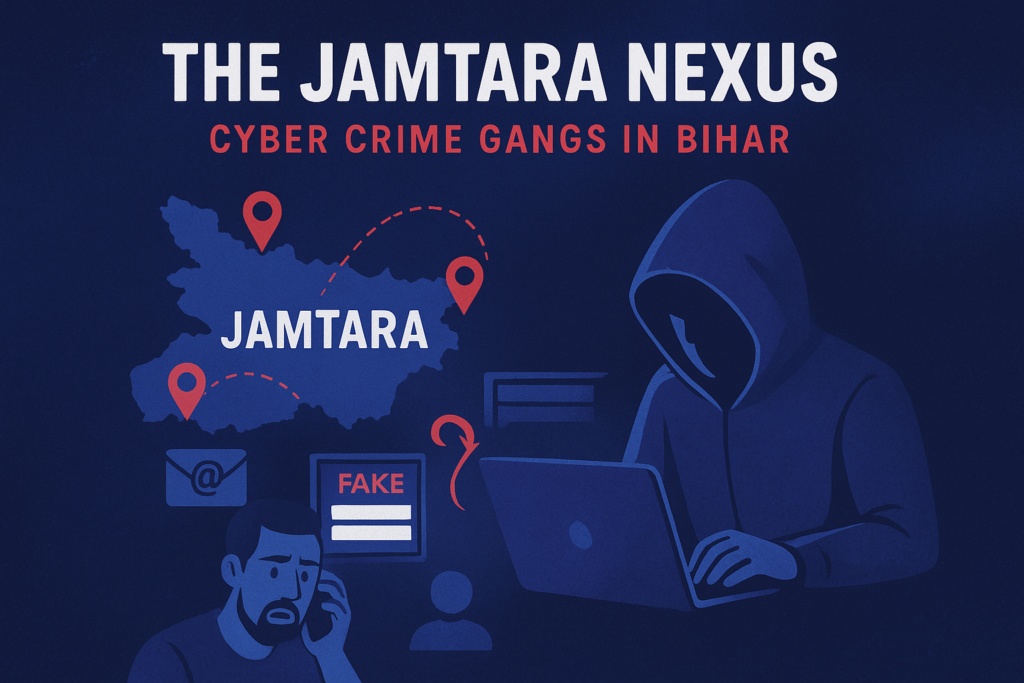
The term “Jamtara Nexus” has become synonymous with India’s growing cybercrime menace. What began as a cluster of phishing operations in Jamtara, Jharkhand, has now evolved into a sophisticated, interlinked network spanning several districts of Bihar, including Gaya, Nawada, and Munger.
The Jamtara cyber crime network represents the dark underbelly of India’s digital revolution — where uneducated youth, social media, and technology converge into a system of deceit. Bihar’s close geographic and socio-economic ties with Jamtara have enabled the spillover of cybercrime expertise across borders, giving rise to what many call the “Digital Crime Belt of Eastern India.”
How the Cyber Crime Gangs Operate
Modus Operandi of Jamtara and Its Bihar Links
The cybercrime gangs in Bihar mirror Jamtara’s operational model. Recruits — mostly aged 18 to 30 — are trained in calling techniques, persuasive phishing tactics, and banking fraud methods. Using fake call centers, they impersonate bank executives, insurance agents, or government officials to obtain OTPs, account details, or Aadhaar-linked information.
The operations are run like small enterprises, where every member has a role:
- Callers (Scammers): Handle voice or WhatsApp calls to potential victims.
- Data Brokers: Purchase leaked data from dark web markets.
- Money Mules: Manage fraudulent bank accounts for fund transfers.
- Handlers: Coordinate between multiple fraud cells across states.
Digital Tools and Social Engineering Tactics Used
These gangs exploit social engineering, SIM swapping, and UPI phishing links to defraud victims. Telegram, WhatsApp groups, and even Facebook communities act as informal “training classrooms.”
Common tools include:
- Fake mobile apps replicating banking interfaces
- VoIP masking software for untraceable calls
- Phishing pages resembling legitimate e-commerce or banking portals
- OTP relay and SMS forwarder apps
The Training Ecosystem – How Recruits Are Groomed
Training in cybercrime isn’t confined to formal setups. Many recruits in Bihar are mentored through peer networks, Telegram channels, and local ‘gurus’ who learned from Jamtara’s original scammers.
A typical training routine includes:
- Learning to mimic official call scripts.
- Practicing UPI fraud through demo apps.
- Acquiring “SIM cards” under fake identities.
- Using proxy servers to hide location data.
These localised “Jamtara schools” thrive due to lack of digital literacy and weak law enforcement awareness, often recruiting underprivileged youth looking for quick income.
Socio-Economic Factors Behind the Jamtara–Bihar Cyber Network
The expansion of Jamtara-style crimes into Bihar can’t be understood without looking at rural unemployment, migration, and digital inequity.
- Many small towns in Bihar suffer from poor job opportunities, making illegal digital ventures lucrative.
- Access to affordable smartphones and cheap data fuels connectivity but not responsibility.
- Weak cyber policing infrastructure makes Bihar vulnerable to spillover crimes from Jharkhand.
This mix of desperation and digital opportunity turns villages into cybercrime incubators — a socio-legal challenge that India must address through education and awareness.
Legal Provisions Governing Cyber Crimes in India
Section 66C & 66D of the Information Technology Act, 2000
The Information Technology Act, 2000 forms the cornerstone of India’s cyber law framework.
- Section 66C penalizes identity theft — using another’s credentials like passwords or digital signatures.
- Section 66D deals with cheating by personation using computer resources, punishable by up to three years’ imprisonment and a fine.
(View full text on India Code)
Relevant IPC Sections: Cheating and Impersonation
Parallel provisions under the Indian Penal Code (IPC) include:
- Section 419: Punishment for cheating by impersonation.
- Section 420: Fraudulently inducing delivery of property.
- Section 120B: Criminal conspiracy, often invoked in gang-based frauds.
These provisions, when read with the IT Act, create a dual liability regime — enabling police to prosecute both digital and physical acts of deception.
Major Crackdowns and Judicial Interventions
Authorities have intensified their focus on the Jamtara–Bihar axis of cybercrime.
In State of Jharkhand vs. Ankit Sharma (2021), the court emphasized the need for swift inter-state coordination between cybercrime units. Similarly, in CBI vs. Unknown (Jamtara Module), national agencies highlighted the role of shared digital intelligence.
CERT-In and MeitY have also issued multiple advisories urging states to enhance cyber forensic infrastructure and public awareness drives.
Case Study – Cyber Fraud Training Racket in Gaya, Bihar
In 2023, the Bihar Police Cyber Cell busted a cyber fraud training module operating out of Gaya. The setup trained around 40 youths using smartphones and online tutorials sourced from dark web channels.
The “students” learned:
- How to send fraudulent UPI payment requests.
- The use of VoIP masking apps.
- How to maintain anonymity through VPNs.
Within two months, the racket was linked to phishing losses exceeding ₹30 lakh across five states.
This case underscores how cybercrime in Bihar and Jharkhand has evolved into a decentralized digital ecosystem — no longer limited to Jamtara alone.
Preventive Measures and Digital Literacy Initiatives
Combating cybercrime requires a multi-pronged approach involving law enforcement, education, and technology.
1. Government Actions:
- Establishment of Cyber Police Stations in every district.
- Training programs under MeitY’s Cyber Surakshit Bharat initiative.
2. Legal Awareness Drives:
- Community sessions on recognizing phishing and fraud.
- School-level digital literacy modules.
3. Citizen-Level Precautions:
- Verify all banking calls through official helplines.
- Avoid sharing OTPs or UPI PINs.
- Use two-factor authentication and secure passwords.
For victims, the National Cyber Crime Reporting Portal offers an easy, centralized complaint mechanism.
Conclusion – Combating the Digital Crime Epidemic
The Jamtara Nexus represents more than organized fraud; it exposes India’s struggle to bridge the gap between digital access and digital ethics. Bihar’s growing involvement reflects the urgent need for cyber law enforcement, awareness, and preventive education.
Until rural India becomes digitally literate and socio-economically empowered, such crimes will persist in evolving forms.
Need legal guidance or wish to file a cybercrime complaint?
Contact Legal Bihar for expert cyber law consultation and representation under the Information Technology Act, 2000.
Frequently Asked Questions (FAQ)
Q1. What is the Jamtara Nexus?
It refers to a network of cybercrime groups operating mainly from Jamtara and nearby Bihar regions, known for phishing and online fraud.
Q2. How are cybercrime gangs trained in Bihar?
Many are trained through informal setups or Telegram groups that teach phishing, UPI fraud, and SIM manipulation.
Q3. What laws apply to such cyber crimes?
Sections 66C and 66D of the IT Act, along with IPC Sections 419 and 420.
Q4. Can victims report cybercrime online?
Yes, via cybercrime.gov.in or at local cyber police stations.
Q5. What punishment is given for online impersonation?
Up to three years’ imprisonment and/or fine under Section 66D of the IT Act.
Q6. Why is Jamtara linked to Bihar’s cybercrime cases?
Due to proximity, socio-economic ties, and migration between districts.
Q7. How to identify a phishing or scam call?
Avoid unknown links, verify caller identity, and never share OTPs.
Q8. Can minors be prosecuted for cybercrime?
Yes, under the Juvenile Justice Act along with relevant IT Act sections.
Q9. What preventive steps can be taken by users?
Use two-factor authentication, strong passwords, and official channels for verification.
Q10. How can lawyers specialize in cybercrime law?
Through certifications and by handling cases before cyber adjudicating authorities or High Courts.
References
- Information Technology Act, 2000 – India Code
- National Cyber Crime Reporting Portal
- Ministry of Electronics and IT (MeitY)
- CERT-In Advisories & Circulars on Cybercrime Prevention
- State of Jharkhand vs. Ankit Sharma (2021) – Cybercrime investigation precedent
Author Bio

Advocate Tabish Ahmad is a technocrat-turned-lawyer with 5+ years of hands-on experience handling complex cyber crime matters including online fraud, UPI/Paytm scams, identity theft, social media defamation, sextortion, CSAM cases, and matrimonial cyber fraud across Bihar and at the Patna High Court.
He is a Certified Cyber Law Expert (Diploma in Cyber Law — Government Law College, Mumbai) and a qualified advocate who passed the All India Bar Examination (AIBE). He currently practices as an Advocate at the Patna High Court, specializing in Cyber Crime Litigation, GST Appeals, and Tax Matters.
Recognized as a top resource person for cyber law awareness programs, he has been invited by UNICEF and other government agencies to conduct training sessions on digital safety, cyber crime prevention, and legal remedies for victims — particularly in Bihar’s districts affected by the Jamtara cyber fraud network.
He serves as President of the Cyber Lawyers Association and is a Member of the Advocates’ Association, Patna High Court. As a Mentor at the Indian Tax Academy and JurisCrack, he trains young lawyers and law students in cyber law practice and digital evidence handling.
Author of multiple books on Cyber Crimes, Taxation, and GST, Advocate Ahmad is known for translating complex IT Act provisions into practical, actionable guidance for victims and litigants.
📍 Office: Table No NA, Shatabadi Bhawan, Path, Advocates Association, Veerchand Patel Road Area, Patna, Bihar 800028
📞 Cyber Crime Helpline: 08002205817
🏛️ Bar Council Enrollment: BR/1272/2022
📧 Consultation: care @legal.bihar.in
🌐 Website: legal.bihar.in
Category: Cyber Crime in Jamtara
Last Updated: June 6, 2026